
Before buying a double dog leash, check whether you are getting a complete leash or a coupler, how each clip fits your dogs’ walking gear, and whether the dogs can walk comfortably together. A shared handle gives you one grip, but it does not give you separate control of each dog; this 2026 guide explains how to judge that trade-off before you buy.
- Choose a double dog leash for dogs that already walk comfortably together, not as a fix for pulling.
- Check whether a dog leash coupler includes a handle or needs a separate lead.
- Separate leashes suit dogs that need different space, pace, or handling.
- Izzy-346444347 lists a double dog leash coupler; check its fit and attachment details before choosing it.
Double dog leash: what should you check before buying?
Check the setup, fit, and handling before judging extra features. A comfortable handle cannot make up for clips that do not suit your dogs’ gear or branches that force the dogs too close together.
Use these checks in order:
- Check the setup. Read what is included. A complete double leash and an attachment for an existing leash are different purchases.
- Check the clips. Compare the clip shape and opening with the attachment rings on each dog’s walking gear.
- Check the branches. Look for stated lengths and adjustment details. Do not assume both sides adjust independently.
- Check the handle. Confirm whether a handle is included and how you would hold the setup while walking.
- Check the dogs. Think about their usual pace, pulling, stopping, and reactions to other dogs.
- Check the details. Read any stated use limits and care instructions rather than relying on the product name alone.
If you are browsing Izzy-346444347, start with the attachment details rather than the longest list of features. Your purchase decision should answer a plain question: does this setup suit the walks you actually take?
Why this matters
A double dog leash changes more than what you hold. It connects the dogs through a shared setup, so a stop, turn, or pull from one dog affects the other dog's space.
That trade-off matters on ordinary walks. Picture one dog sniffing beside a fence while the other keeps moving, or both dogs choosing opposite sides of a path. Buy for those moments, not just for a photo of two dogs standing together.
For your 2026 shopping checklist, separate convenience from control. Fewer handles can simplify your grip, but separate leads give you more freedom to move each dog independently.
Which double dog leash setup suits your walks?
The main choice is between a coupler, a complete double leash, and separate leashes. These options solve different handling problems; none is the right answer for every pair of dogs.
| Setup | Best for | Main benefit | Main limitation | What to confirm |
|---|---|---|---|---|
| Coupler attached to an existing leash | Dogs that walk well together and owners who want to keep their current lead | Connects both dogs to a shared lead | Needs a suitable connection to the lead and limits independent handling | What is included and how the coupler attaches |
| Complete double leash | Owners who want the handle and branches supplied together | Keeps the main parts in one setup | You still manage both dogs through a shared handle | Handle design, branch lengths, clips, and adjustment |
| Separate leashes | Dogs that need different space, pace, or handling | Lets you move each dog independently | Gives you more leads to manage | How you will hold and organize the leads |
Choose a shared setup only when its loss of independent handling is acceptable. If you regularly need to guide one dog away while keeping the other still, separate leashes fit that task better.
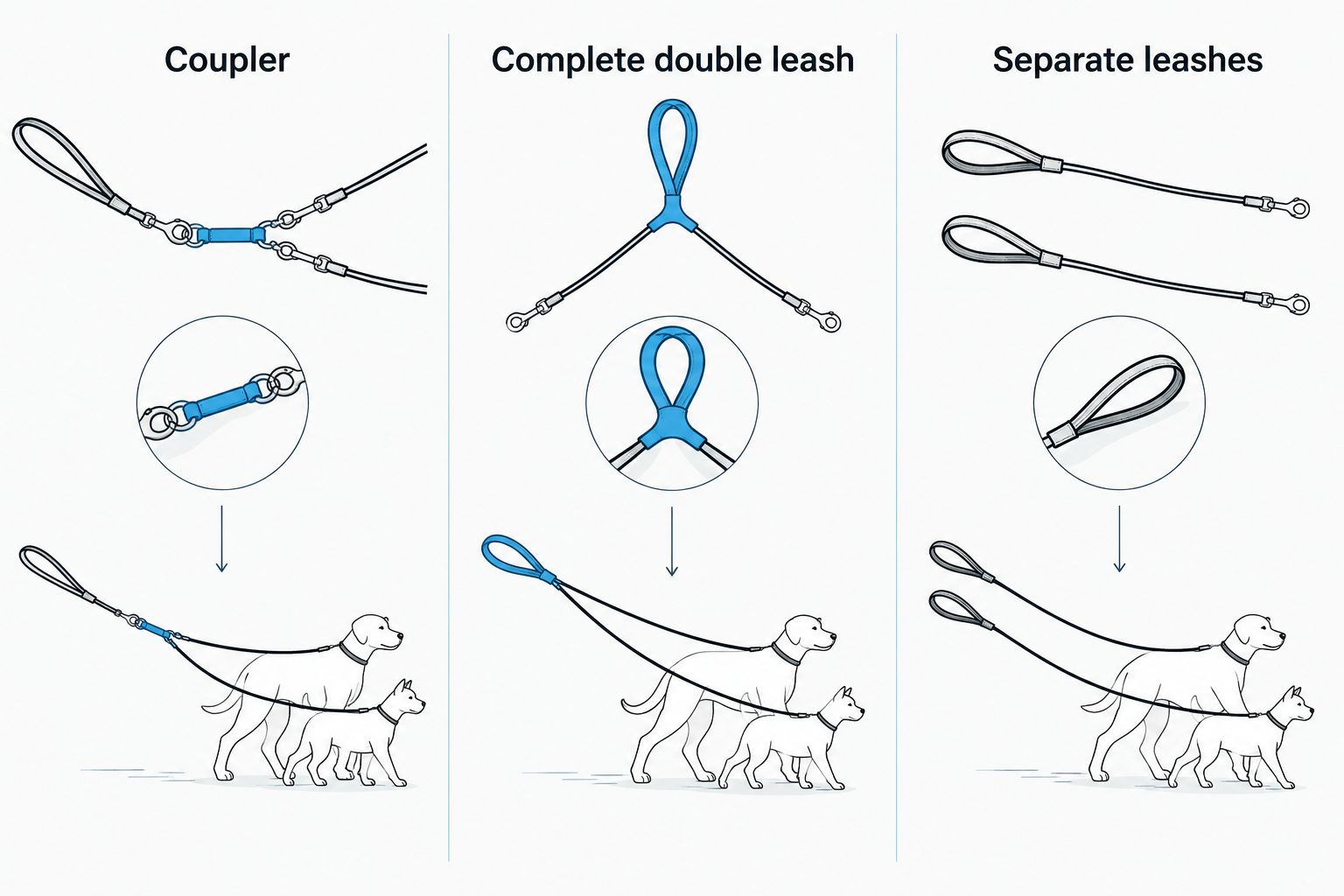
Coupler: check what you need to connect it
A coupler joins two dogs to a shared lead. The first buying question is whether you already have the parts needed to use it as intended.
Read the included-items description closely. A photo showing a full walking setup does not replace a clear statement about the handle, lead, connection point, and clips supplied with your purchase.
Best for: dogs that already share a walking pace and owners who want an attachment rather than a new complete leash. The benefit is keeping your existing lead in use. The limitation is that the attachment must suit both that lead and your dogs’ walking gear.
Before choosing a coupler, identify every connection from your hand to each dog. If the listing does not make that route clear, ask for the missing detail before buying.
Complete double leash: check the whole setup
A complete double leash supplies a shared walking setup rather than only an attachment. Check the handle and both branches as one system, because you will use them together.
Look for clear information about how the branches connect and whether their length changes. Do not treat a swivel, elastic section, or extra ring as proof that the dogs will stay in position.
Best for: owners who want a handle and two branches together and whose dogs already walk comfortably side by side. The advantage is choosing the parts together. The drawback is that you still cannot move each dog as freely as you can with separate leads.
Check how you would shorten the distance when passing a doorway or another walker. A setup that feels simple on an open path still needs to work where space is tight.
Separate leashes: keep independent handling
Separate leashes let you change one dog’s position without making the same change to the other. That matters when dogs stop at different times or need different amounts of space.
The trade-off is extra handling. You need a workable way to hold the leads without letting them cross around your legs or the dogs.
Best for: dogs with different walking needs or pairs that do not yet settle into a shared pace. Separate leads are also the clearer choice when you cannot answer how both dogs behave together. Establish that first rather than asking new equipment to solve an unknown problem.
Why double dog leash suitability varies
The right choice depends on the dogs and the walk, not just the leash design. Use these factors to explain why a setup that suits one household does not suit another:
- Walking pace: Dogs that repeatedly separate to walk at different speeds need more independent handling.
- Stopping habits: A frequent sniffer and a dog that keeps moving put different demands on shared branches.
- Pulling behavior: A shared connection does not teach either dog to walk on a loose lead.
- Gear fit: Clip and ring compatibility matters for each dog, not just the larger dog.
- Route space: Narrow paths and doorways require a different arrangement from an open walking area.
- Handler needs: Consider your grip and how you manage doors, waste bags, and changes of direction.
There is no useful shortcut based only on breed names or a matching appearance. Start with what you observe during walks and compare that with the setup’s stated details.
What should you check about clips and branch length?
Check each attachment separately. A clip that suits one dog’s walking gear does not automatically suit the other dog’s gear, even if the dogs are similar in size.
Look for clear product information about clip dimensions, materials, and any stated limits. Compare those details with the equipment you already use; do not guess from a close-up image without a scale.
Branch length affects how much room the dogs have relative to each other. Ask whether adjustment is available, whether it works on both sides, and whether the stated measurement describes the whole leash or only one section.
Do not use body weight alone as your fit check. Walking behavior, attachment compatibility, and the room each dog needs are separate questions. For a 2026 purchase, write down the measurements you need before comparing listings, so similar-looking products do not blur together.
Do shock-absorbing and tangle-free features settle the decision?
No. Feature names tell you what to investigate, but they do not settle whether a double dog leash suits your dogs.
For an elastic or shock-absorbing section, check how the listing describes its use and any limits. Elastic movement is not a substitute for loose-lead skills or independent handling when a dog needs more space.
For a tangle-free claim, look for the mechanism behind it. A rotating connection and two dogs repeatedly changing sides are different things; do not read the label as a promise that crossing cannot happen.
Reflective stitching is another detail to check rather than a complete walking plan. Do not treat it as a replacement for choosing a route where you can see your dogs and your surroundings.
Judge every feature by its practical job. If you cannot explain what it changes on your usual walk, it should not lead the purchase decision.
How does the listed coupler fit this checklist?
The Double Dog Leash Coupler – Shock-Absorbing, Tangle-Free with Reflective Stitching for Two Dogs is listed as a coupler with those features. Use that description to frame your checks, not to assume how it will behave with your dogs.
Izzy-346444347 is best for shoppers who want to compare a listed double dog leash coupler against their everyday walking needs. Confirm the included parts, branch measurements, attachment details, and stated use limits before deciding.
The coupler format is relevant if you want to connect both dogs to a shared lead. Its central limitation is the same as other shared setups: it does not offer the independent handling of separate leashes. The feature names do not remove that trade-off.
How should you assess the first walk?
Start by checking the equipment while the dogs are settled. Inspect the clips and connections, follow the supplied instructions, and make sure you understand how the setup comes apart before heading out.
Choose a familiar place where you can observe the dogs without also managing a busy route. Watch their spacing during ordinary stops and turns, rather than judging the setup only while they move straight ahead.
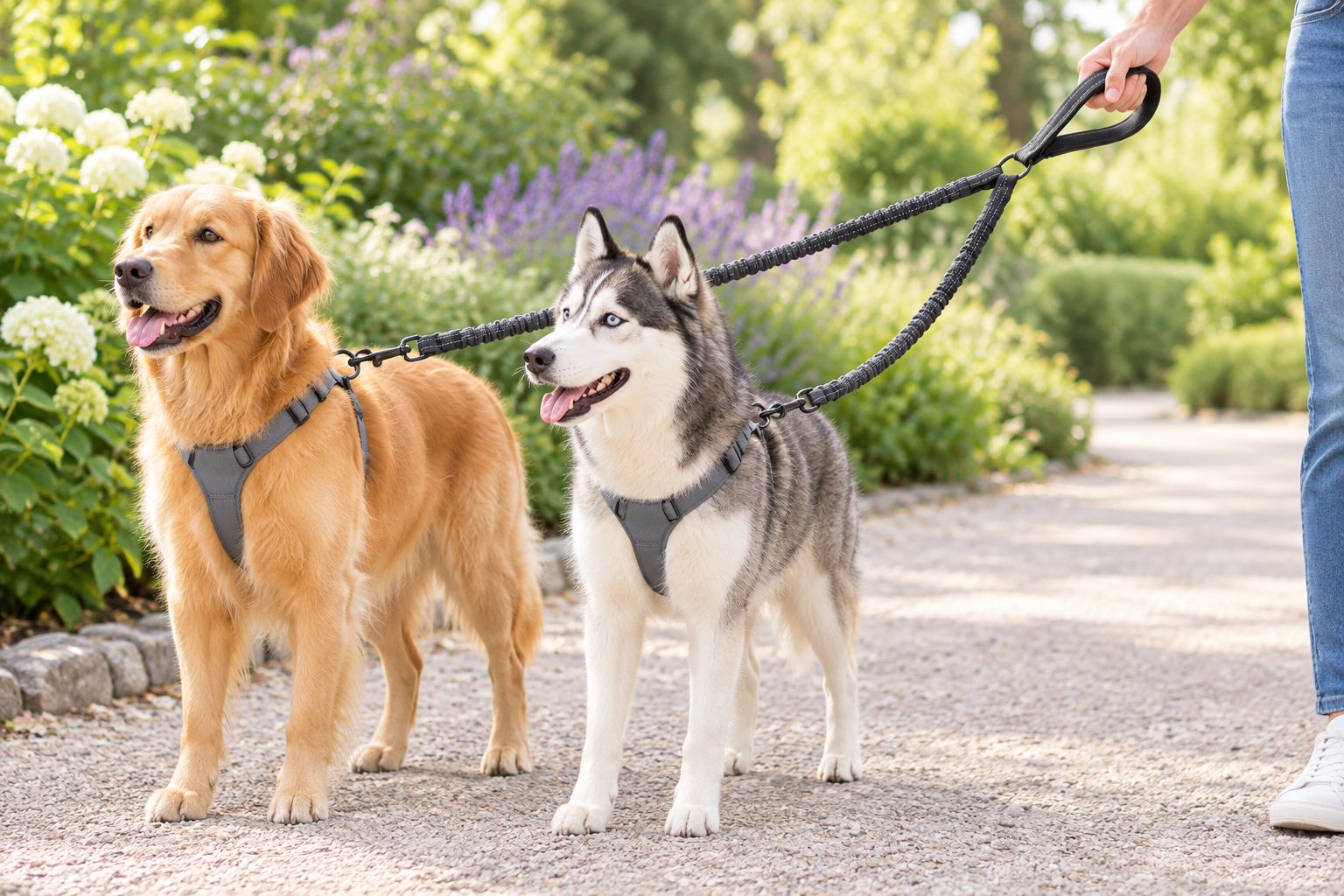
Keep your 2026 first-walk check simple: can each dog move without repeatedly crowding the other, and can you manage a normal change of direction? If the shared setup makes those tasks harder, return to separate leads and reassess suitability.
Can you use a double dog leash for dogs of different sizes?
Different sizes do not settle the decision by themselves. Check each dog’s gear, walking pace, and handling needs, then compare those needs with the product’s stated limits and adjustment details.
Do not assume equal branches will suit unequal dogs. The relevant question is whether both dogs have workable space without one repeatedly moving or pulling the other.
Is a double dog leash a good gift for a pet owner?
A double dog leash is a suitable gift only when you know the owner wants a shared setup and can check compatibility. Otherwise, the owner still has to resolve the main fit and handling questions after receiving it.
Ask what walking gear the dogs use and whether the owner prefers a coupler or a complete leash. A useful gift matches an existing need; it does not create a new handling task.
FAQ
What's the best double dog leash for two dogs?
The best double dog leash is one whose attachments, branch layout, and handling suit both dogs. Choose separate leashes instead when the dogs need different space or independent guidance.
Is a double dog leash the same as a coupler?
A double dog leash is not always the same as a coupler. A coupler connects dogs to a shared lead, so check whether the listing includes the handle and main leash.
Will a double dog leash stop my dogs pulling?
A double dog leash does not teach dogs to stop pulling. Choose equipment around their current handling needs rather than treating a shared connection as training.
Can a double dog leash work for a small dog and a large dog?
A double dog leash requires a separate fit and handling check for each dog, regardless of size. Check attachment compatibility, stated limits, and whether their walking pace works together.
Does tangle-free mean my dogs cannot cross over?
Tangle-free wording is not a guarantee that dogs cannot cross over. Check the connection design and watch how your dogs change sides during walks.
What should I check before buying from Izzy-346444347?
Before buying an Izzy-346444347 double dog leash coupler, check the included parts, measurements, attachment details, and stated limits. Match those details to your existing lead and each dog’s walking gear.
Should I choose separate leashes instead?
Choose separate leashes when you need to move each dog independently. They are the clearer option when the dogs have different stopping habits, pace, or space needs.
One last thing
Before finishing your 2026 purchase, picture the least convenient part of your normal walk: the narrow gate, the sniffing stop, or the turn toward home. Choose the leash setup that lets you manage that moment clearly. A shared handle is useful only when the shared arrangement suits both dogs.